.png)
1. Project Overview
This project aims to develop measures that will provide a safer and more comfortable environment in the Shibuya Station area, where problematic street drinking has become prevalent, and to contribute to improving the well-being of local residents. To achieve this, the project involves the collection of data and the implementation of safety measures.
2. Background and Recognition of Issues
Problematic street drinking has become a persistent issue in the areas surrounding Shibuya Station, leading to serious concerns such as littering and noise disturbances. In response, Shibuya City enacted an ordinance prohibiting drinking in public spaces year-round, which came into effect on October 1, 2024.
However, street drinking continues to be observed, and the city conducts nightly activities through its Safety and Security Patrol Team to request voluntary restraint from individuals engaged in such behavior.
In light of this situation, the project explores new solutions by leveraging startup technologies while also collaborating with existing countermeasure teams to improve the efficiency of current security operations.
3. Implementation
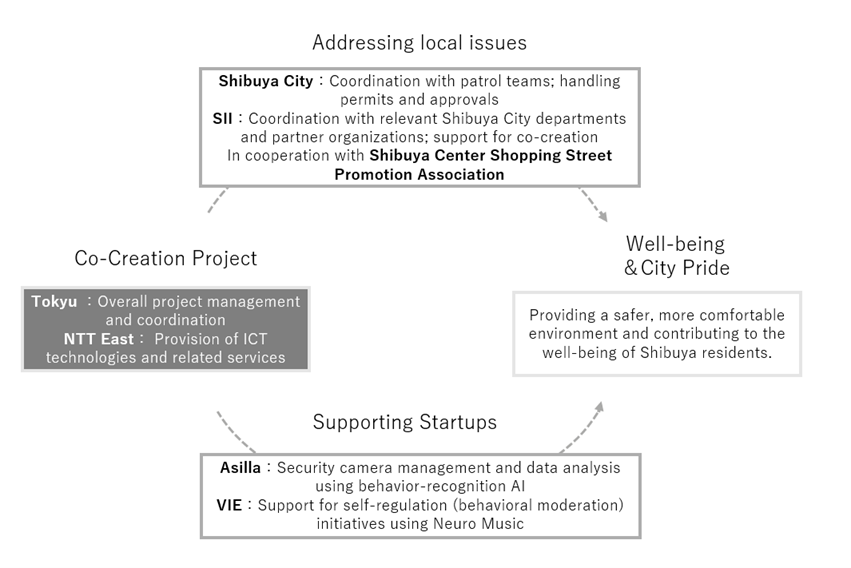
This project was carried out as a member project of the Shibuya Innovation Institute (SII), in collaboration with Shibuya City. It involved member companies such as Tokyu Corporation and NTT East, two startups (Asilla, Inc., which provides behavior recognition AI technology, and VIE, Inc., which develops Neuro Music technology), as well as the Shibuya Center Shopping Street Promotion Association.
A pilot demonstration was conducted in the Shibuya Station area from November 2025 to April 2026, focusing on verifying the effectiveness of the following two technological solutions:
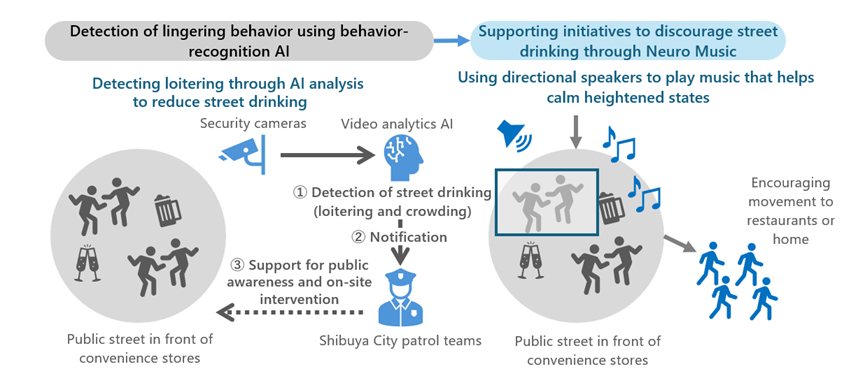
・ Detection and Sharing of Loitering Using Behavioral Recognition AI
Security cameras installed in Shibuya Center-Gai were equipped with a behavioral recognition AI system developed by Asilla, Inc., which analyzed video footage to automatically detect individuals who remained in one location for a certain period, including those likely engaged in street drinking.
Detection data was shared with patrol teams in real time, and the collected data was analyzed by day of the week and time of day. This enabled the creation of heat maps visualizing patterns of loitering and potentially problematic behavior.
As a result, the project contributed to optimizing the deployment of security personnel and patrol schedules based on data-driven insights.
・ Support for Voluntary Restraint Using Neuro Music
A directional speaker was installed in a section of Shibuya Center-Gai, where Neuro Music was developed by VIE, Inc. designed to induce a relaxed state through theta brainwave frequencies — was played within a limited area.
The effects of this intervention on loitering behavior were examined.
During the approximately two-week field test, the playback area was limited to locations where street drinking was most likely to occur. Sound volume and speaker direction were carefully adjusted to ensure minimal impact on nearby shops and pedestrians.
By comparing the data from the behavioral recognition AI system, changes in the number of loitering individuals with and without music were quantitatively measured.
4. Findings
・ Improvement of Security Operations Through Data Utilization
The accumulation and analysis of detection data from the behavioral recognition AI enabled a quantitative understanding of when and where loitering frequently occurs during late-night hours.
The resulting heat maps aligned with the patrol teams’ on-the-ground sense of the situation, generating feedback such as:
“The identified peak times and days match our field experience.”
“Visualization through data will be useful for future security planning.”
“We were able to consider strategically deploying security personnel as needed.”
Based on these insights, the project proposed improvements to patrol operations aimed at enhancing efficiency and reducing workload through data-driven methods.
・ Reduction of Loitering Using Neuro Music
In the field demonstration using Neuro Music, an average reduction of approximately 70% in the number of loitering individuals was observed between midnight and 1:00 AM, suggesting a potential deterrent effect.
The effect was particularly pronounced around 1:00 AM, when the surroundings become quieter, and statistically significant differences were confirmed.
Even excluding conditions such as rainy weather, which naturally reduces foot traffic, a decrease of over 30% on average was recorded, suggesting that some degree of effect could be expected.
However, during relatively busier time periods, the effect was less pronounced in some cases. Further verification and optimization of implementation conditions will be necessary to achieve more consistent outcomes.
・ Establishment of a Public-Private Co-Creation Model
This project represents a successful public-private co-creation model in which government, private companies, and local organizations worked together to address urban challenges.
By leveraging the resources of SII member organizations, it was possible to demonstrate innovative technologies developed by startups such as Asilla, Inc. and VIE, Inc..
The integration of diverse expertise and technologies was a key factor in the project's success. Additionally, the collaborative process itself—where government and private entities shared real-world challenges and co-developed solutions—serves as a valuable precedent for accelerating the social implementation of startup technologies.
The knowledge gained through this project has the potential to be applied as a universal model to other urban issues, such as street smoking and late-night noise disturbances in different regions.
5. Future Outlook
This demonstration has attracted significant interest from other regions. By systematizing and disseminating the insights gained as the “Shibuya Model,” the project aims to expand its application to similar urban challenges, including street smoking and late-night noise.
Moving forward, SII and its partner organizations will continue to collaborate with government bodies and local communities, building on the results and lessons learned from this project to contribute to the creation of safe, secure, and sustainable urban environments.