
【This translation was generated by AI.】
1. What Is the Talk Event "The Power of Dialogue"?
Shibuya City's vision is "Turning Differences into Strength." Dialogue, which has been drawing growing attention in recent years, is one approach that lets people experience this idea firsthand. We hope to spread a culture of dialogue across many fields — welfare, culture, education, civic activities, industry, and more — so that dialogue becomes part of everyday life.
Following "Dialogue Electronica," a program that lets participants discover the joy of dialogue through art appreciation, we held the talk event "The Power of Dialogue." Hearing from guests who practice dialogue in a wide range of fields, participants learned what kinds of changes dialogue is creating on the ground — and left feeling inspired to try dialogue themselves.
2. Highlights from the Event

Our three guests are each pioneering unique initiatives that generate dialogue.
- Wataru Asada (Cultural Activist)
An artist, writer, and university lecturer who uses expression (music and words) to invent "unexpected ways of connecting with others."
- Norie Mitsuki (Representative Director, NPO ARDA)
An art educator and planner who trains facilitators of dialogue-based art appreciation in museums and local communities.
- Kenta Fujiwara (Director, General Incorporated Association Bench)
An arts and culture coordinator and certified social worker who works across welfare and the arts, promoting artist-in-residence programs.
The event was facilitated by Yutaka Yamauchi (Representative Director, Donner le mot).
As an introduction, Mr. Yamauchi presented the appeal and potential of dialogic approaches, drawing on practical examples such as "philosophical dialogue" at Miyazaki Higashi High School and the "School of Community Design," an initiative that generates local activities through dialogue.
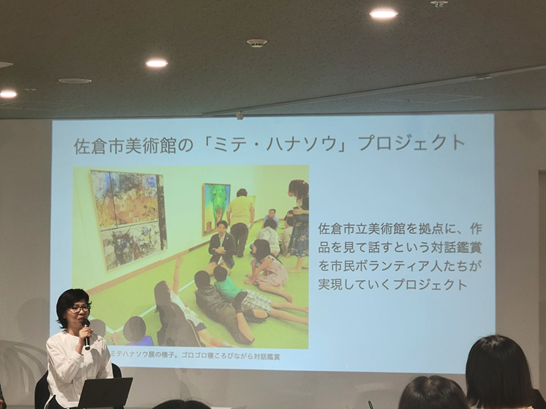
The guest talks followed. First, Norie Mitsuki, who works on dialogue-based art appreciation, introduced the "Mite Hanasou" (Look and Talk) project at the Sakura City Museum of Art. In this program, local residents served as facilitators for dialogue-based viewing sessions during a summer exhibition of the museum's collection. She reported that the repeat participation rate among elementary school students reached 50%, and that after years of this work, a curator remarked that "the works in this museum are fortunate." The dialogic approach shows how citizen facilitators and children can become active creators of the value of cultural resources.
Next, arts and culture coordinator Kenta Fujiwara introduced a case of artist residencies at a care facility for older adults. Rather than artists engaging with the facility only briefly through recreation programs, they stayed over a long period — and remarkable relationships emerged. Dialogue and communication with the residents drew out the artists' creativity, while the residents themselves also seemed energized by the exchange.
Finally, cultural activist Wataru Asada introduced an art project at a facility for people with disabilities. The project turned the welfare facility into a "radio station," broadcasting conversations with the facility's users (members) as a radio program. Through this approach, the relationship of "staff who support" and "users who are supported" was reconfigured into one of "staff producing the talent (users) appearing on the program" — dramatically changing the quality of conversation between users and staff.

In the cross-talk session that followed, the guests explored what their dialogic approaches have in common. Through dialogue, existing relationships change — and through that change, the potential each person holds begins to open up. At the same time, the guests noted that such dialogic situations rarely arise spontaneously. The discussion concluded that devices and ideas that create the conditions for dialogue — like a "radio program" or a "dialogue-based art viewing workshop" — are essential.

At the end of the event, participants tried a mini version of the art appreciation experience from Dialogue Electronica. After an introduction to the basic rules of dialogue-based viewing, participants paired up for a "blind talk" using the painting "South Wind" by Sanzo Wada. One person looked at the painting and described it, while the other — unable to see it — asked questions and imagined the work. The whole venue then viewed the actual painting together in a dialogue-based session. Comments poured in from many different perspectives, and participants experienced how their image of the artwork kept transforming.
3. Outcomes and Next Steps: Growing Expectations for Places of Dialogue
With both talks and hands-on experiences, "The Power of Dialogue" was a lively event. In the post-event survey, 50% of respondents said they would like to take part in dialogue sessions, and 28% said they would like to create such opportunities themselves — a clear sign of growing momentum. Participants shared comments such as: "Freely expressing my thoughts and ideas broadens my world and enriches my life. Opportunities like this are rare, so I hope there will be many more," and "I felt the power of dialogue in getting to know other people's thinking and expanding my own values." The event helped build the mindset behind Shibuya City's vision of "Turning Differences into Strength" — recognizing and drawing power from each other's values and perspectives.
Text: NPO Donner le mot
